Thursday, September 30, 2010

I can tell that we are gonna be friends...


I’d like to ask you a simple question: how many friends do you have? Well, at first glance it seems simple, but in reality it’s not that clear to get an answer, especially when you add in the social networking machine that is Facebook. Think about it, many people have friends on Facebook that they hardly know, and some people have friends that they haven’t even met and don’t have any mutual friends with. I didn’t think I’d be able to say this, but now that I’ve taken a second to think about what I’ve just stated I’m embarrassed to say I fit into both of those categories.
            Facebook is very curious in that aspect, for some reason people we would never say were our friends in real life are our friends in Facebook life. Sometimes I’ll just be browsing, okay the more appropriate term may be creeping, through pages and I’ll notice I have a Facebook “friend” I forgot about and think to myself “why on Earth am I friends with this person? I don’t even like them.”
In fact though, the word creeping brought me to a point that works with this whole friendship thing. The point is that even though I question why I’m friends with them in respect to the fact that I don’t even like the person it’s an irrelevant thought. Facebook friending doesn’t really mean being friends, it means giving someone the right to creep through your life. Most of the activity that goes through friendships on Facebook isn’t seen. Most of the activity done is merely observation. In fact, so much of Facebook is comprised of creeping that it’s not uncommon to hear people go on about gossip and utter the words “I saw it on Facebook.” That’s where the lines between real life friendship and Facebook friendship start to blur, and when you get there it’s quite a mess.
Maybe we’ll never know completely who’s a “real” friend and who’s a Facebook friend, but with real life and Internet life meshing into one it’s getting a lot harder to say that it will ever be completely possible to distinguish.  But I’ll leave this thought for later, I’m going to go update my status.

Wiki wiki pedia pedia


So, while perusing the wondrous domain that is the online community of encyclopedic knowledge that is Wikipedia I decided to edit the pick-up line page. Clearly this was of the utmost importance to the academic community and so I proudly took the initiative to update the world about pick-up line information that may not have been known to previous Wikipedia readers. So, as I got to the page I dutifully clicked on the link to edit the article and purposefully scribed a subsection that was glaringly missing from the article: Harry Potter pick-up lines.
Okay, so maybe not everybody cares about Harry Potter pick-up lines (even though I believe that they should), but our class assignment was to edit a Wikipedia article and seeing as that I had looked up Harry Potter pick-up lines instead of studying for my government exam the day before (which I aced by the way, feel free to short me dirty looks for that) it was a topic I knew I could contribute to. It was pretty simple adding in my own subsection, though admittedly I did look up formatting information; but considering I’ve never edited a Wikipedia article before it was very user friendly. I suppose that’s both a good and a bad thing. The good part is that since it’s user-friendly people who know a topic well can easily input information that can aid people who know little to nothing about said topic. The bad part is that since it’s user-friendly people who don’t know a topic well can easily input information that can hurt people who know little to nothing about said topic.
The bad side being said though, I hear that Wikipedia has a pretty good system set-up getting rid of incorrect or irrelevant information. I know first-hand that my old high school computers were blocked from editing articles because too many false reports were added from the computer. Also, upsettingly I found a few days later that my addition to pick-up lines had been removed. I assume it was because of the irrelevance of the information on the larger scheme of things. So Wikipedia does have some safety in the validity of its information.
So Wikipedia has its good and its bad, and I suppose it’s up to each user whether they will trust its information or not, but I for one will continue to use it as a jumping off block until I get deeper into the topic I’m researching.

Saturday, September 18, 2010

Micro-blogging

So I’ve been thinking about social media, and in particular I think I’ll target blogging. It seems appropriate seeming as this is a blog itself. Now, for a while I’ve kept up my own personal tumblr, which is a site designed for micro-blogging. This is for me the best method of blogging. I’ve had to create personal blogs for other classes throughout my high school career and currently I have two that I have to keep up for my college courses, but those have never seemed to stick for me. It’s not that sites for true blogs are too terribly confusing, but I much prefer the simplicity of sites like tumblr. When you log in it’s nice because you are directed to your dashboard page which updates consistently with new posts from people who you’re following as well as giving you alerts to if a person made some sort of note on your posts. In a way it’s kind of like the twitter interface, only in my opinion much less confusing (plus you don’t have that annoying symbol limit that comes with tweets). I find myself going to my tumblr a lot more often than anything else (other than the addiction that is facebook) simply because I have a good deal of freedom with it while paired with the simplicity. Also, I can control how much I want to write still. The beauty of the set up is that it doesn’t look too weird to have a long post stuck in with some other short posts, pictures, videos, or audio clips. I overall find it very user friendly and would suggest others to try it out. The only issue is that you might find yourself more focused on your tumblr than on your blog.

Saturday, September 11, 2010

What and How?

So I kind of  messed up and did this week's post last week, so I'm going to do last week's post this week. Nifty how that works out, eh?
I'm going to discuss the Martin McLuhan piece. Quite frankly one of the more interesting yet mind-boggling articles we have read in this class. I really enjoyed the discussion of how all media actually works through another form of medium. However, at the same time it is such a jumbled portrayal of these ideas that it could be at times nearly incomprehensible. Honestly, it inevitably goes into the whole situation/institution of slavery and it just gets rather upsetting. Why does everything that would be so simple and lovely change into something that’s so dismal in comparison? Why does the simplest ideas get transformed into the most convoluted, destructed concepts? Even know everything I set out to do in this post has been twisted and turned into this mass of confusion. Perhaps this is a perfect representation of the article in my own way. But, perhaps not.

Friday, September 3, 2010

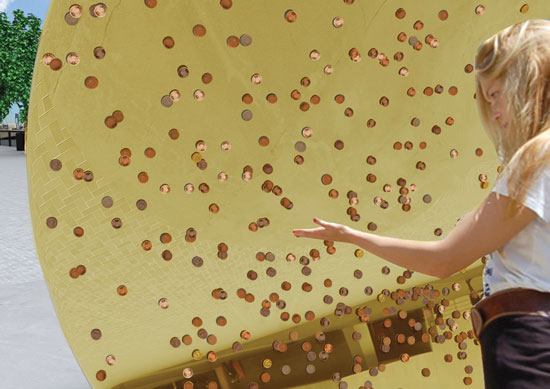
So as we go into the realm of emerging social media, I can't help but of course tie that into art. I mean, it's not a stretch by any means because media and art go hand-in-hand, but I just love it when art pieces incorporate that social element. It adds a new level of communication so as it being not just the artist to the public, but also the public to each other. In the 2010 London Design Festival, designer Paul Cocksedge did just that, as covered in the Designboom Daily Coverage article david chipperfield + paul cocksedge installations at london design festival 2010. The article touches on Cocksedge’s piece “Drop” and goes on to explain further saying 
"'drop' is magnetic and encourages passers-by to participate by affixing their spare pennies
to its surface, facilitating a human connection with an otherworldly object and allowing individuals
to alter the appearance of the installation. 'drop' thus becomes copper-plated through many small acts
of human contribution. at the end of the installation, the public's monetary contributions will be
counted and barnardo's corporate partners will turn every penny into one pound."
 I for one find it to be a great utilization of art merging it with social media aims. By making it interactive (as much of today’s culture is surrounded upon) it gets people to forge a network with causes in need of assistance. The art incorporation assists in this because people are forging that network in a sometimes unconscious state. Personally, I think this is a more productive way of incorporating media and social elements in with social causes because I believe that people are more inclined to make that connection when an actual tactile element is involved. To me this shows that the fine arts are still strongly tied to the media, even if they are at times not viewed in such a way, and are continuing to make a social network that is stronger and more intimate than the likes of internet social networking like the ever addictive facebook.


image courtesy of designboom